
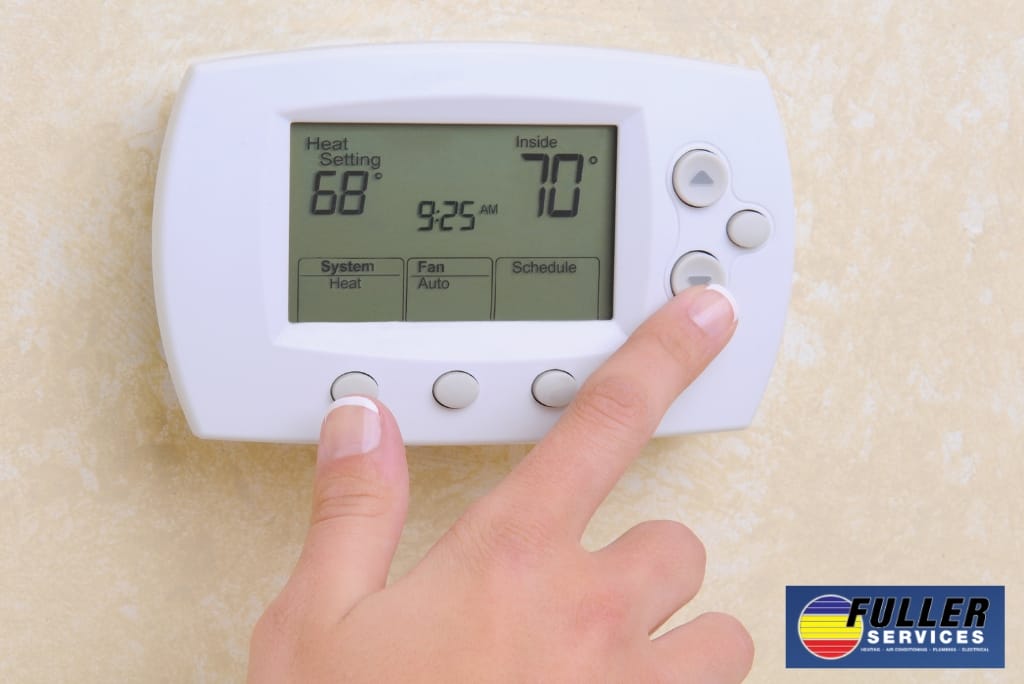
The thermostat is the most-touched control in a North Alabama home, and it is also the most argued about. Summers in Muscle Shoals and Florence run hot and heavy with humidity. Winters swing from mild to a hard freeze inside the same week. So what temperature to set the thermostat is not one number. It is a short set of numbers that change with the season, the time of day, and whether anyone is home. Fuller Heating, Air Conditioning, Plumbing & Electrical works in these houses every day, and the settings below are the ones that hold up in the Tennessee Valley, along with the reasons the standard national advice sometimes falls apart here.
What temperature should you set your thermostat in summer?
Set cooling to 78°F when the house is occupied and awake, then 85°F while everyone is gone. ENERGY STAR publishes both numbers as its summer benchmark for a typical home.
Fuller Heating and Air treats 78°F as a floor to work up from, not a comfort promise. Raise the setting one degree at a time and hold it for several days before deciding it does not work. Close blinds on west-facing windows through the afternoon, run ceiling fans counterclockwise in rooms people are actually sitting in, and dress for the season indoors. Most Florence households find they can live at 77°F or 78°F once air movement is part of the plan.
One caution is specific to this region. 78°F in the Shoals is not the same experience as 78°F in a dry climate, because humidity does most of the damage to summer comfort here. If the house feels sticky rather than hot, the fix is moisture removal and airflow, not a lower number on the wall. Fuller’s cooling services page covers that side of the problem, and the humidity section below explains the physics.
The table below is the short version for a North Alabama household.
| Season | When Home | When Away | Notes |
|---|---|---|---|
| Summer | 78°F | 85°F | ENERGY STAR summer benchmark |
| Winter (gas furnace) | 68°F | 60°F to 62°F | Standard 7 to 10 degree setback |
| Winter (heat pump) | 68°F | 65°F to 66°F | Limit setback to 2 or 3 degrees |
| Sleep (summer) | 76°F to 78°F | Not applicable | Cool the bedroom with fans, not the house |
| Sleep (winter) | 62°F to 65°F | Not applicable | Sleep Foundation range is 60°F to 67°F |
| Vacation (summer) | Not applicable | 85°F | Prevents humidity damage and mold |
| Vacation (winter) | Not applicable | 55°F to 60°F | Prevents frozen pipes |
What temperature should you set your thermostat in winter?
Set heating to 68°F when the house is occupied and awake, and 60°F to 62°F while everyone is asleep or away. The U.S. Department of Energy puts the savings from a setback of 7 to 10 degrees, held about eight hours a day, at roughly 10% a year on heating and cooling.
Fuller services heating equipment across North Alabama, where winter is short but not gentle. A Muscle Shoals home may run the furnace hard for three weeks in January and barely touch it in March. That pattern makes a programmed schedule more valuable than a single fixed number, because the savings come from the hours the house sits empty, not from suffering through a cold evening.
Two adjustments are worth making.
- Households with infants, older adults, or medical needs should treat 68°F as a starting point and move up a degree or two without guilt.
- And if the home runs on a heat pump rather than a gas furnace, the 7 to 10 degree setback advice does not apply cleanly. That exception gets its own section below, and Fuller’s heating services team corrects the resulting bills every winter.
What is the best thermostat setting for sleeping?
The Sleep Foundation puts the ideal bedroom range at 60°F to 67°F, and most adults settle between 65°F and 68°F. Core body temperature drops as you fall asleep, and a cooler room lets that drop happen on schedule instead of fighting it.
Fuller Heating, Air Conditioning, Plumbing & Electrical does not recommend dropping an entire Florence house to 65°F on an August night. Cooling every empty room to bedroom temperature costs far more than the comfort it buys. A better approach through a North Alabama summer is to hold the house near 78°F and make the bedroom itself feel cooler with a ceiling fan, breathable bedding, and blinds that keep late-day sun out of the room.
Winter is easier. Dropping from 68°F to 62°F overnight lines up with both the sleep research and the Department of Energy setback guidance, so comfort and savings point the same direction. A programmable thermostat handles the change without anyone remembering to touch it, which is the only way a sleep schedule survives past the first week.
What should you set the thermostat to when you leave the house?
For a normal workday absence, set cooling to 85°F in summer and heating to 60°F to 62°F in winter. For a vacation, hold summer cooling at 85°F rather than shutting the system off, and keep winter heating at 55°F to 60°F.
Those vacation numbers have little to do with comfort. Fuller Heating, Air Conditioning, Plumbing & Electrical sees the summer version of this mistake in Muscle Shoals every year: a family turns the air conditioning off for a week in July, and the house comes back to indoor humidity well above 60%, musty air, and sometimes visible mold on closet walls. Running the system at 85°F costs very little and keeps moisture in check. In winter, 55°F is the freeze-protection line for pipes running through crawlspaces and exterior walls.
One exception matters more here than almost anywhere else. A deep setback on a heat pump does not save money the way it does on a gas furnace, because the system calls for auxiliary electric heat to climb back to setpoint. Keep heat pump setbacks to 2 or 3 degrees, or use a smart thermostat with a true heat pump mode that ramps recovery gradually. North Alabama has a high share of heat pump homes, so this applies to a lot of Shoals households.
How much does each degree actually cost you?
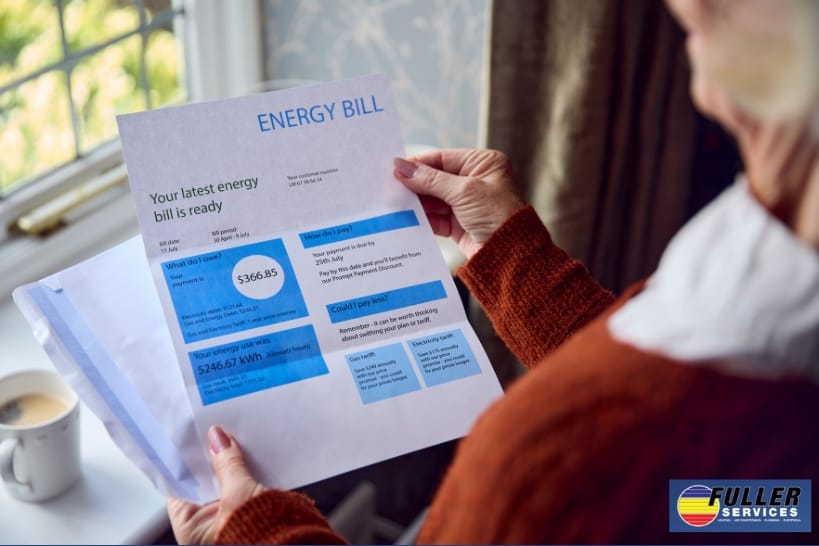
The most defensible figure comes from the U.S. Department of Energy: setting the thermostat back 7 to 10 degrees for about eight hours a day can cut heating and cooling costs roughly 10% a year. The popular claim that each single degree saves 3% is repeated everywhere, but studies suggest the real number swings widely with climate, insulation, and equipment, so treat it as a direction rather than a promise.
For a Florence home, the first two or three degrees are worth the most and the returns flatten after that. Fuller Heating, Air Conditioning, Plumbing & Electrical suggests testing it directly: hold a new setting for a full billing cycle, then compare against the same month last year and account for how hot the summer actually ran. A tuned system responds to a setback the way it should, and routine HVAC maintenance is what keeps that true.
Equipment efficiency sets the baseline every setting works against. SEER2 ratings explain why two Muscle Shoals homes sitting at the same 78°F can land on very different bills, and an older unit will always give back less for the same degree of setback.
Why 78 degrees feels different in North Alabama than it does elsewhere
78°F at 60% indoor relative humidity feels several degrees warmer than 78°F at 30%, and North Alabama sits firmly on the humid end of that scale. Sweat evaporates slowly in moist air, so the body sheds heat less efficiently even though the thermometer reads exactly the same.
Fuller Heating, Air Conditioning, Plumbing & Electrical serves Muscle Shoals, Florence, Sheffield, Tuscumbia, and Athens, and July dew points across the Tennessee Valley routinely sit at or above 70°F. A dew point in that range is the practical definition of oppressive. It also means an air conditioner here is doing two jobs at once: lowering temperature and pulling moisture out of the air. In a desert climate the second job barely exists, which is why the same setpoint produces two different experiences.
ASHRAE Standard 55 defines the indoor comfort zone using humidity as well as temperature, and 30% to 60% relative humidity is the accepted comfort range for occupied spaces. Below 30% the air feels dry and static-prone. Above 60% comfort falls off quickly and mold risk climbs. Florence homeowners who say the house never feels cool are frequently sitting at 75°F and 65% relative humidity, which is a humidity problem wearing a temperature costume.
How humidity changes the right thermostat setting
If the house feels hot at 75°F, the thermostat is probably not the problem. Indoor relative humidity above 60% makes any set temperature feel warmer, and it is the most common comfort complaint Fuller hears from North Alabama homeowners through July and August.
Put an inexpensive hygrometer in the main living area. If it reads 75°F and 65% humidity, chasing comfort by dropping the thermostat to 71°F will run the compressor harder, cost more, and still leave the room clammy. The better move is to make the system dehumidify properly: change a loaded filter, clear the condensate drain, confirm supply and return registers are open, and have refrigerant charge and airflow checked. An oversized air conditioner is a frequent culprit, because it satisfies the thermostat quickly and shuts off before it has removed much moisture.
Local climate turns this into a long season rather than a few bad weeks. Data on how often Florence breaks 90 shows how many days the Shoals asks an air conditioner to run at full load. When filter changes and airflow corrections are not enough, a whole-home dehumidifier paired with the existing system lets a Muscle Shoals house sit comfortably at 77°F or 78°F instead of 73°F.
Thermostat settings for a heat pump vs. a gas furnace
Gas furnace homes can use the standard 7 to 10 degree setback without penalty. Heat pump homes should not. A setback deeper than 2 or 3 degrees usually triggers auxiliary electric strip heat during recovery, and strip heat costs far more per unit of warmth than the heat pump itself.
The mechanism is simple. A heat pump moves heat rather than creating it, and it does that slowly and efficiently. When the thermostat suddenly demands a 7 degree climb, the system cannot get there fast enough on its own, so the control board brings on resistance heat to close the gap. The homeowner saved eight hours of gentle heat pump operation and paid for forty minutes of the most expensive heat in the house.
Fuller Heating, Air Conditioning, Plumbing & Electrical installs and services both system types across North Alabama and corrects this setting regularly on winter calls in Muscle Shoals and Athens. The fix is either a flat winter setpoint or a smart thermostat with genuine heat pump support and adaptive recovery, which starts warming early and gently instead of calling for strip heat.
Programmable and smart thermostat schedules that actually save money

A schedule saves money only if the household actually lives by it. Fuller Heating and Air Conditioning recommends building the schedule around the hours a North Alabama home is genuinely empty, then leaving it alone for a full month before judging it. Here is a weekday template that works for most Florence and Muscle Shoals households.
| Time | Recommended Setting |
|---|---|
| 6:00 a.m. | Cooling at 76°F to 78°F, heating at 68°F, timed to arrive before anyone gets up. |
| 8:00 a.m. | Cooling at 85°F, heating at 62°F for the workday. Skip the winter half of this step on a heat pump. |
| 4:30 p.m. | Return to the comfort setting so the house is ready by 5:30. |
| 10:00 p.m. | Cooling at 76°F to 78°F with a bedroom fan, heating at 62°F for sleep. |
| Weekends | Run the occupied settings and drop the away block entirely. |
Smart thermostats add three things worth paying for: geofencing that ends the away block when a phone crosses back into town, learning algorithms that measure how long recovery actually takes in one specific house, and weather-aware pre-conditioning ahead of a Tennessee Valley heat wave. Heat pump owners should confirm the model supports heat pump staging before buying.
None of that rescues a neglected system. A Comfort Club membership keeps the equipment behind the schedule tuned, which is what lets a programmed setback actually land instead of turning into a long recovery run every afternoon.
Before the first hard freeze, work through winterizing your HVAC so the heating side of the schedule has something reliable to run on. If the system cannot keep up with the schedule you set, the schedule is not the problem.
When a thermostat setting is not the problem
Optimized settings will not rescue a system with a mechanical fault. If the bill stays high or the house never reaches setpoint, look at dirty filters, leaking or disconnected ducts in a crawlspace or attic, low refrigerant charge, equipment past 15 years old, improper sizing from a replacement that skipped a load calculation, and insulation gaps in the attic. Older construction adds its own challenges, covered in our guide to HVAC issues in Northern Alabama homes built before 1980.
Short cycling, weak airflow at the registers, rooms that never match the rest of the house, and a thermostat reading that does not match how the room feels are all signs the trouble lives downstream of the setting. Fuller Heating, Air Conditioning, Plumbing & Electrical has diagnosed these faults in Muscle Shoals, Florence, Sheffield, Tuscumbia, and Athens since 1991.
A homeowner can check the filter and confirm registers are open. Everything past that needs gauges, static pressure readings, and a load calculation. HVAC service in Florence starts with finding which of those causes is actually driving the complaint, so the right thermostat setting has a working system underneath it.
Frequently asked questions about thermostat settings
What temperature should I set my thermostat in the summer?
Set it to 78°F when you are home and awake, and 85°F when the house is empty. Fuller Heating, Air Conditioning, Plumbing & Electrical treats that as a North Alabama starting point rather than a fixed rule. If the house feels sticky at 78°F, check indoor humidity before lowering the number.
What temperature should I set my thermostat in the winter?
Set it to 68°F while home and awake, dropping to 60°F or 62°F while asleep or away. Households with infants or older adults should feel free to run 69°F or 70°F. Heat pump homes are the exception and need a much shallower setback.
What is the best thermostat temperature for sleeping?
The Sleep Foundation puts the range at 60°F to 67°F, and most people settle between 65°F and 68°F. Body temperature falls at sleep onset, and a cooler room supports it. Through a Florence summer, cool the bedroom with a fan rather than dropping the whole house.
What should I set my thermostat to when I am not home?
Use 85°F for cooling and 60°F to 62°F for heating during a workday absence. For vacations, hold 85°F in summer to control humidity and 55°F to 60°F in winter to protect pipes. Never shut the system off entirely during a Muscle Shoals summer.
Does turning the thermostat lower cool the house faster?
No. A standard single-stage air conditioner has one output level, so choosing 68°F instead of 74°F does not add capacity. It only makes the system run longer and overshoot, which wastes energy and can leave the house cold and still damp.
Should I set back the thermostat if I have a heat pump?
Only a shallow one. Keep heat pump setbacks to 2 or 3 degrees, because a deeper drop calls on auxiliary electric strip heat during recovery and costs more than the setback saves. A smart thermostat with genuine heat pump support handles the ramp automatically.
How much money does each degree save?
The Department of Energy figure is roughly 10% a year from a 7 to 10 degree setback held about eight hours a day. The widely repeated 3% per degree claim lacks a clear primary source, so studies suggest treating it as a rough direction rather than a guarantee.
Is 78 degrees really comfortable in Alabama?
Yes, when indoor humidity is under control. At 30% to 60% relative humidity with ceiling fans running in occupied rooms, 78°F is comfortable for most Shoals households. At 65% humidity it is not, and the answer there is dehumidification rather than a colder setting.
Should I leave the fan on auto or on?
Auto for most North Alabama homes. Leaving the fan running continuously in summer can re-evaporate moisture off the indoor coil and push humidity back into the house. Use the On setting for short stretches when you want to even out temperatures between rooms.
What indoor humidity level should I aim for?
Aim for 30% to 60% relative humidity, with 45% to 55% as the summer sweet spot in the Shoals. Above 60% invites mold and dust mites and makes any temperature feel warmer. A cheap hygrometer in the living room tells you more about comfort than the thermostat display does.