
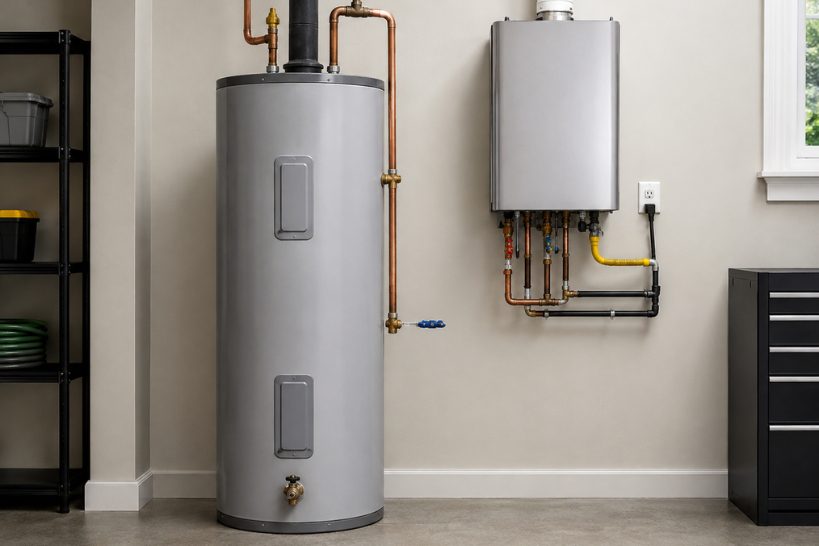
Standing in front of a leaking water heater or shivering through a cold shower forces an urgent choice: do you replace your existing tank like-for-like, or upgrade to a tankless system?
Rushing this decision under pressure can lead to an expensive mistake. Across the Tennessee Valley, hard water adds extra complexity. High mineral content accelerates scale buildup, directly affecting how long each system lasts and what it costs to maintain.
This practical decision guide breaks down what you need to know before buying, including a plain-English cost framework and a side-by-side comparison table. You will learn how upfront retrofit costs, long-term energy savings, and local water quality all factor into the right choice.
As licensed plumbers who install and service both tank and tankless water heaters across North Alabama, we outline the three key factors that determine the best fit for your home.
Tank vs Tankless Water Heater: Storage vs. On-Demand Heating
Imagine running your washing machine while someone takes a shower upstairs. A standard tank water heater draws from a pre-heated 40- or 50-gallon reservoir. Once that stored water empties, you must wait for the tank to reheat before hot water returns.
A tankless system heats water on demand as it flows. Instead of overall capacity, output is measured in gallons per minute (GPM) at a specific temperature rise. A common misconception in the tank vs tankless comparison is that tankless units deliver truly instant hot water. They do not. They eliminate standby heat loss, but the water still travels through the pipe before it reaches your tap.
This mechanical shift drives every comparison:
- Costs: Simple tank swaps versus retrofitting gas or electrical capacity.
- Comfort: Instant tank delivery versus initial delays and flow limits.
- Maintenance: Hard water scale affects both, but tankless heat exchangers are particularly sensitive.
Because Fuller installs both options, reviewing what a tankless install includes helps you choose the right fit.
Which Water Heater Fits Your Home? A Quick Decision Matrix
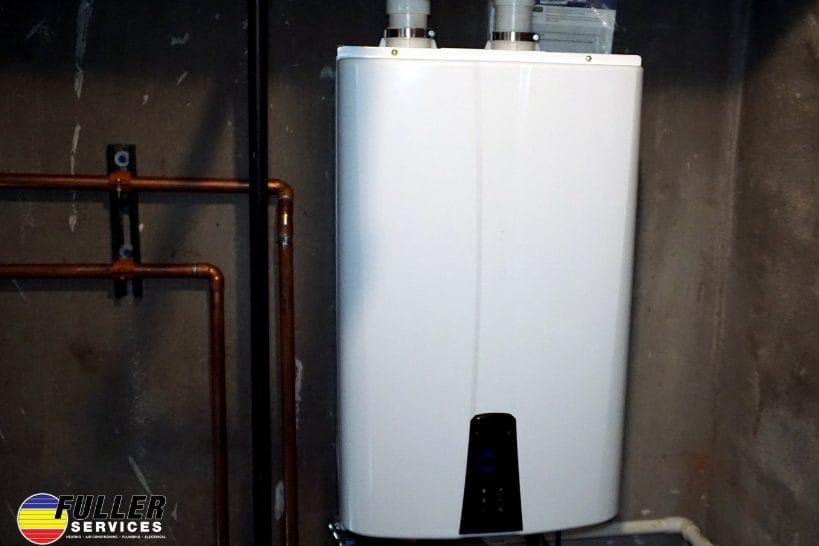
You might assume upgrading to a tankless water heater always saves money, but for many North Alabama homeowners, sticking with a traditional tank is the smarter financial move. Evaluating a tank vs tankless water heater means looking at household size, infrastructure, and long-term plans all at once.
| Your Situation | Best Fit | Why |
|---|---|---|
| Tight upfront budget | Traditional Tank | A traditional tank offers the lowest initial equipment and replacement costs. |
| Limited space or want to reclaim a closet | Tankless | A tankless unit’s compact, wall-mounted footprint frees up valuable floor space. |
| Large family or back-to-back showers | Tankless | A properly sized tankless system delivers continuous hot water for periods of high demand. |
| Older home with unknown utility lines | Traditional Tank | A tank may avoid the gas line or electrical panel retrofits sometimes required for a tankless system. |
| Hard water concerns | Traditional Tank | Tankless heat exchangers require strict annual descaling to manage mineral buildup. |
| Staying in the home for 3 to 5 years | Traditional Tank | The lower upfront cost generally makes more financial sense for a shorter ownership period. |
| Staying in the home for 10+ years | Tankless | Tankless systems have a longer payback period but can provide better long-term value. |
| Generator-friendly backup | Standard Gas Tank | A standard gas tank may continue operating during a power outage, depending on its ignition and control system. |
If you are on the fence, a professional sizing assessment and water-quality test usually decide the winner. Local mineral content heavily affects performance, making it essential to understand how hard water interacts with each system type before choosing.
Do not guess on this decision. The next section breaks down the exact upfront costs and performance trade-offs of each system.
Upfront Price vs. Lifetime Cost: The Real Math Behind Water Heater Replacement
Did you know equipment alone typically accounts for only 30 to 50 percent of your total water heater replacement cost? A tankless unit with a $1,200 sticker price can quickly reach $3,500 or more installed once you factor in gas line upgrades, venting, and electrical work. That gap is especially wide for older homes in North Alabama.
The cheapest option upfront is rarely the cheapest to own over a decade. Comparing a tank vs tankless water heater means looking at three distinct cost buckets:
| Cost Bucket | What It Covers | Key Consideration |
|---|---|---|
| Equipment | The physical water heater unit itself. | Traditional tanks typically cost significantly less upfront than tankless models. |
| Installation and Retrofits | Labor, installation materials, and any required gas line, venting, or electrical upgrades. | This is often the largest cost swing factor when comparing tank and tankless systems. |
| Ongoing Ownership | Monthly energy bills, routine maintenance, and potential repair parts. | Long-term operating and maintenance costs can affect the total value of each system over its lifespan. |
When converting from a tank to a tankless system, ask your installer if these common retrofit line-items are included:
| Retrofit Line Item | What It May Require |
|---|---|
| Gas Line Upsizing | High BTU demand often requires upgrading from a 1/2-inch to a 3/4-inch gas line. |
| Specialized Venting | Category IV venting materials and dedicated condensate drain lines may be needed. |
| Electrical Upgrades | Dedicated outlets or additional panel capacity may be required for electronic controls and freeze protection. |
| Recirculation Solutions | Pumps or buffer tanks can help eliminate cold water delays at distant faucets. |
Long-term value depends heavily on maintenance. Standard tank heaters last 8 to 12 years with periodic flushing and anode rod replacements. Tankless units last 15 to 20 years but require annual descaling to reach that lifespan. Factor both when calculating true cost of ownership.
If you want a quote that includes all retrofit items upfront, we can help you evaluate your options on our water heaters page.
What ‘Endless’ Hot Water Really Means: Delta-T, Winter Flow, and Daily Quirks
Picture stepping into a steaming shower in January, only for the water to turn lukewarm when someone starts the dishwasher downstairs. That sudden drop happens because tankless output depends on Delta-T, which is the temperature difference between incoming cold water and your target hot water temperature.
In North Alabama, groundwater drops to roughly 45 degrees F in winter compared to 70 degrees F in summer. Reaching a standard 120 degrees F requires a 75-degree lift during colder months. That increased workload can cut a 7 GPM unit down to 4 to 5 GPM, which may not be enough for simultaneous high-draw fixtures.
Beyond system sizing, tankless water heaters present three everyday quirks:
- Ignition delay: Water must flow before the burner fires, creating a brief wait at distant taps.
- Minimum flow activation: Fixtures drawing under 0.5 GPM may not trigger heating.
- Cold-water sandwich: Pausing the water creates a short cold pocket between hot streams.
Recirculation pumps solve delays by keeping hot water staged in the line, while small buffer tanks eliminate cold-water bursts. Fuller’s tankless water heater services pair proper sizing with comfort upgrades like water quality treatment to prevent scale build-up and maintain reliable performance year-round.
Hard Water Reality: Tank vs. Tankless Water Heater Performance
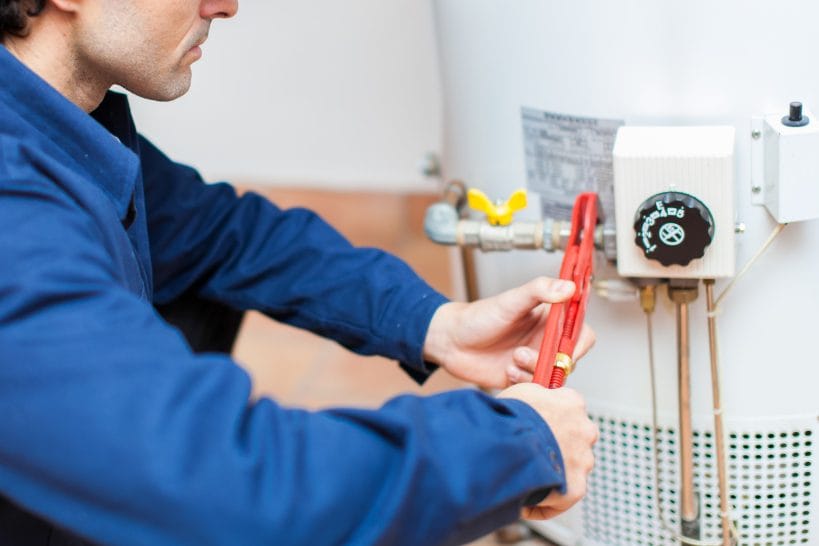
You might think upgrading to a tankless unit guarantees hassle-free hot water, but hard water can damage a tankless system faster than a standard storage tank. Dissolved minerals create scale buildup that shortens equipment life, reduces efficiency, and in severe cases, voids manufacturer warranties.
Hard water shows up differently depending on the unit:
| Water Heater Type | How Hard Water Affects It |
|---|---|
| Tank Water Heaters | Minerals settle as bottom sediment, insulating heating elements, reducing storage capacity, and accelerating anode rod wear. |
| Tankless Water Heaters | Scale bakes directly onto heat exchanger passageways, restricting flow, triggering error codes, and increasing overheating risks. |
Protecting your investment requires routine maintenance and service logs to safeguard warranty coverage. Standard tanks need annual flushing, while tankless units require descaling every 12 to 24 months, more often above 10 grains per gallon.
If your water tests above 7 grains per gallon (GPG), installing a whole-home water softener filtration system is often a smarter first step than upgrading to tankless alone. Treated water extends the life of both system types and reduces maintenance frequency.
Read our breakdown on how hard water damages water heaters to learn more. Enrolling in the Comfort Club keeps your annual descaling on schedule so your system stays protected.
Choosing the Right Water Heating Strategy for Your North Alabama Home
Deciding between tank and tankless comes down to balancing upfront investment, home infrastructure, and local hard water demands:
| Recommendation | Best Fit When |
|---|---|
| Choose a Traditional Tank | You want the lowest initial cost, prefer a straightforward like-for-like replacement, or plan to move within five years. |
| Choose a Tankless System | Endless hot water and saving space matter most, your electrical or gas lines support the retrofit, and you are prepared for annual descaling. |
| Get a Professional Assessment | Hard water buildup is active on fixtures, you want faster hot water delivery, or your electrical panel or utility capacity remains uncertain. |
Before You Buy Checklist:
- Count peak simultaneous hot water demands: showers, laundry, dishes.
- Confirm your existing power source: gas or electric.
- Check potential retrofit requirements: venting, electrical panel, gas line diameter.
- Test local water hardness to plan proper scale protection.
To compare detailed model specifications, explore our tankless water heater services page. Ready to find the right system for your home?
Call (256) 381-7195 for a Free Assessment
Frequently Asked Questions About Water Heater Upgrades
Are tankless water heaters worth it?
Tankless water heaters are worth the investment if you prioritize endless hot water, need extra space, and plan to stay in your home long-term.
- Comfort and space: You gain continuous hot water and free up valuable floor space.
- Financial payback: Long-term energy savings offset upfront costs, but full ROI depends on retrofit expenses, proper maintenance, and your time horizon.
What are the biggest tankless water heater pros and cons?
The main advantage of a tankless unit is continuous hot water without standby heat loss, while the main downside is the initial retrofit cost.
- Pros: Unlimited hot water, compact wall-mounted sizing, and improved overall energy efficiency.
- Cons: Higher upfront installation costs, flow limits during simultaneous usage, and sensitivity to mineral maintenance.
How does hard water affect a tankless water heater?
Hard water creates scale that bakes onto the narrow passageways of a tankless heat exchanger. Over time, this restricts water flow, reduces efficiency, and can void your manufacturer warranty.
- Scale risk: High mineral content forces the burner to work harder, accelerating internal wear.
- Maintenance impact: Annual descaling becomes vital to maintain performance.
What’s the typical tankless water heater lifespan vs a tank?
A properly maintained tankless water heater lasts 15 to 20 years or more, whereas traditional storage tanks usually last 8 to 12 years.
- Base longevity: Tankless units offer up to double the service life of traditional storage models.
- The multiplier: Routine flushing and good water quality are essential to reach the 20-year mark.
Why does my tankless have temperature swings or a cold burst?
Temperature swings occur when residual hot water in the pipe is followed by a short gap of unheated water before the burner reignites, creating a cold water sandwich effect.
- System delay: Turning a tap off and on creates a momentary cooling gap during ignition.
- Available solutions: Installing a recirculation pump or a small buffer tank eliminates cold bursts entirely.
Do I need a water softener if I go tankless?
Your need for a softener depends on local mineral levels, but pairing water treatment with a tankless unit is a smart choice across North Alabama.
- Protection: Softened water prevents scale from clogging sensitive heating components.
- System pairing: Treating hard water protects both your unit and plumbing infrastructure.
If you are unsure which system fits your home, scheduling an in-home evaluation will help you make the right call.