
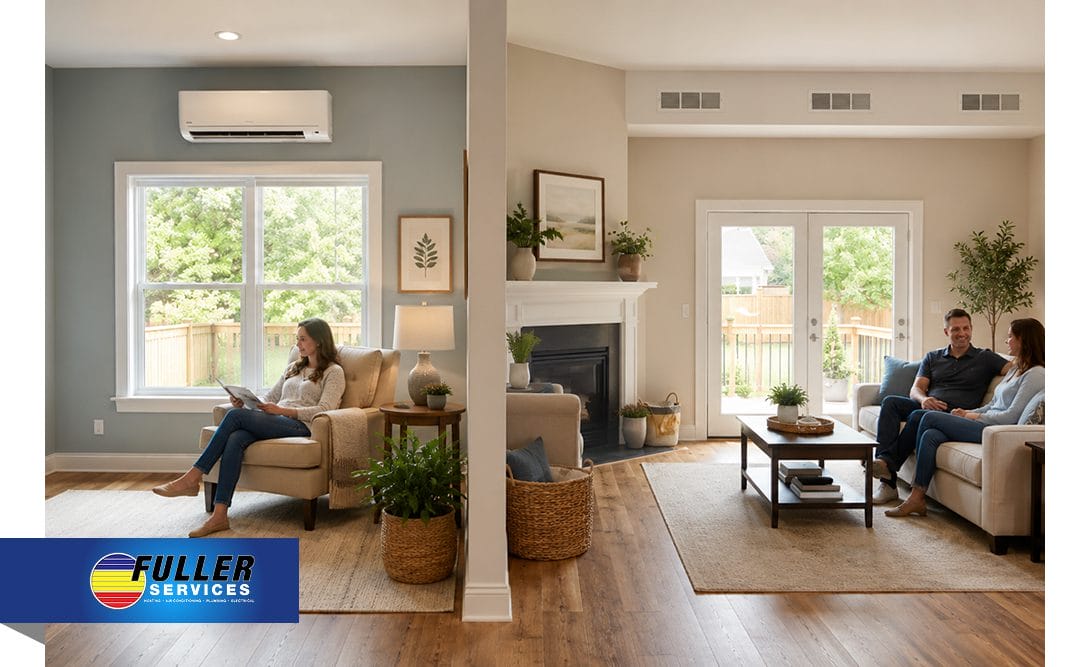
Does your upstairs bedroom feel like a sweltering Alabama sauna while your downstairs living room is freezing? If you are dealing with uneven room temperatures, rising summer utility bills, or aging, leaky ductwork, you are likely weighing a ductless mini split vs central AC to restore comfort to your living spaces.
But choosing the best AC system for your home is not a simple debate about which technology is technically superior. It is a practical decision that depends on your property’s unique physical layout, your comfort goals, and the total installed cost of the project.
To help you make a confident, long-term investment, this guide goes beyond basic efficiency ratings. We compare real-world comfort delivery, long-term energy savings, yearly maintenance, and the “hidden” electrical or structural upgrades that often catch homeowners by surprise. By the end, you will have a clear decision path based on your household budget and how your family actually uses your rooms.
Both systems distribute air differently — and that difference matters.
How Each System Works: The Mechanics of Comfort
Many homeowners assume their air conditioner works by blowing icy air into a room to lower the temperature. Your cooling system does not “make cold” at all. It acts as a heat magnet, absorbing indoor heat and humidity and moving it outdoors. While both options rely on this fundamental process of heat transfer, they distribute comfort in completely different ways.
A traditional central AC conditions air in one central location using an outdoor condenser, an indoor evaporator coil, and an air handler. A heavy blower fan pushes this treated air through a network of hidden supply and return ducts. In your living spaces, you will only see subtle wall registers and grilles, with the entire home functioning as a single zone managed by one thermostat.
A ductless mini-split bypasses ductwork entirely. It pairs an outdoor compressor with one or more visible, wall-mounted indoor blower units. These components connect directly through a small conduit housing the refrigerant lines and condensate drain, allowing you to set different temperatures for individual rooms. For homeowners who want to explore these zoned configurations further, our ductless mini-split systems page covers installation options and equipment in detail.
In Northwest Alabama, the physical condition of your existing ductwork is often the deciding factor. For many Shoals-area homes, leaky or uninsulated ducts turn central air into an expensive energy drain, making ductless systems a highly efficient alternative.
Solving Real-World Comfort Issues: Room Temperature and Zoning
Is the bedroom over your garage 5 to 8 degrees hotter than the rest of the house? During humid North Alabama summers, uneven temperatures can turn bonus rooms and additions into unusable spaces. When comparing a ductless mini split vs central AC, the best choice depends on how your home layout handles airflow.
Here is how each system addresses these real-world comfort challenges:
- Ductless mini-splits: These systems offer precise room-by-room zoning. Variable-speed inverter compressors eliminate temperature swings and provide targeted dehumidification. Installing too few indoor heads, though, will leave some rooms without coverage.
- Central AC: This setup distributes air evenly across a standard floor plan when ductwork is sized correctly. The risk lies in the duct system. Undersized or poorly routed ducts create permanent hot and cold spots. If your comfort issues stem from a failing system or faulty ductwork, a professional AC repair inspection is the right starting point.
For many Shoals-area homeowners, a hybrid approach offers the perfect balance. You can keep your existing central AC for the main home footprint and install a single-zone ductless mini-split to handle a stubborn bonus room, a finished basement, or a new sunroom.
Noise is another consideration. Ductless indoor units sit on your wall and operate with a gentle whisper. Central systems keep mechanical noise tucked away, but unbalanced static pressure can cause loud, rushing air at your vents.

How Ducts and Zoning Affect Your Power Bills
According to the Department of Energy, typical ducted cooling systems lose 20 to 30 percent of their conditioned air through leaks, holes, and poor connections. (Department of Energy, 2023) That hidden loss means a system with a high seasonal efficiency rating can still waste energy and push up your utility bills.
Efficiency is measured by SEER2 (Seasonal Energy Efficiency Ratio). But real-world utility bills depend heavily on how your system delivers air:
- Ductless mini-splits: Bypassing ducts entirely prevents energy loss. These systems use variable-speed inverter compressors to match your cooling needs precisely, meaning you only pay to cool active spaces.
- Central AC: These systems can be highly efficient when paired with well-designed ductwork and variable-speed blowers. They must condition the entire house, though, which wastes energy in empty rooms.
To predict which option saves you more money, run through this quick checklist:
- Duct location: If your ducts run through a hot Alabama attic and you suspect leaks, central AC efficiency hinges on duct repair first.
- Room usage: If you only use three or four rooms most days, the zoning advantage of a mini-split delivers real savings.
No matter your choice, restricted airflow from dirty filters or clogged coils will force either system to run longer. Booking regular seasonal tune-ups keeps your equipment at peak efficiency and protects your budget.
The Real Installation Cost: Five Line-Item Buckets
Does skipping ductwork make a mini-split the automatic budget winner? Many homeowners assume so, but retrofitting an entire house with a multi-zone system often costs significantly more upfront than replacing a standard central system. Because there is no single honest “average” price, budget using five line-item categories:
- Equipment: The physical outdoor compressor and indoor air handlers.
- Labor: Routing refrigerant lines, electrical connections, and system commissioning.
- Ductwork: Repairing, sealing, or installing new ducts (bypassed with mini-splits).
- Electrical: Dedicated circuits, outdoor disconnects, and potential panel upgrades.
- Permits: Local Northwest Alabama municipal fees.
Your choice typically hinges on three budget scenarios:
- Ducts in good shape: If your home already has functional ductwork, a central AC replacement almost always wins on upfront cost.
- No ducts or failing ducts: If installing brand-new ductwork would add a major upfront cost, a multi-zone mini-split often wins on comfort and long-term operating costs.
- Problem areas only: If you only need to condition a single sunroom, bonus room, or garage, a single-zone mini-split is your most cost-effective option.
The biggest budget surprise many contractors leave off quotes is electrical capacity. Multi-zone mini-splits and high-capacity central systems draw substantial simultaneous load. If your home has an older 100-amp panel, you may need a service upgrade to 200-amp to meet local electrical codes. Have your contractor verify panel capacity before you sign anything.
Noise Specs to Request
Always ask your contractor for manufacturer submittals showing decibel (dB) ratings. Compare the indoor head rating (typically 19 to 30 dB, quieter than a library) against the outdoor condenser (often 50 to 60 dB) to protect your home’s peace and quiet.
If you are weighing cooling options, our HVAC installation and replacement page walks through how we design and size these systems. When you are ready, schedule an appointment with Fuller HVAC, Plumbing and Electrical for a transparent, itemized estimate.

Upkeep, Lifespans, and the DIY Trap
Imagine installing a new mini-split yourself, only to have a tiny refrigerant leak ruin the compressor three weeks later. When you call for help, you discover the manufacturer voided your warranty because a licensed contractor did not commission the system. This scenario plays out often, which is why long-term HVAC success depends on professional installation and proper maintenance.
Each system has distinct ongoing maintenance requirements to reach its 12-to-15-year lifespan:
- Ductless mini-splits: Require washing mesh filters in every indoor head every 2 to 4 weeks, periodic deep coil cleanings, and checking mechanical condensate pumps.
- Central AC: Demands changing a single return filter every 1 to 3 months, checking ductwork insulation, and flushing gravity-fed drain lines annually.
While “quick-connect” DIY kits are marketed as weekend projects, proper commissioning is more involved. It requires evacuating lines with a vacuum pump to remove moisture and pressure-testing flare connections. Leftover moisture creates a destructive acid that ruins the compressor. Leading brands require licensed technicians to install and register equipment to secure their 10-year parts warranties.
Climate matters too. Because both options rely on heat pump technology, freezing Northwest Alabama winters will reduce their efficiency. Central systems easily integrate backup heat strips, but standard ductless setups often require specialized low-ambient models to keep you warm when temperatures drop below freezing.
To protect your investment and keep your home comfortable year-round, work with Fuller HVAC, Plumbing and Electrical for certified HVAC services tailored to your Shoals-area home.
Choosing the Right Cooling Strategy for Your Shoals Home
Deciding between central air and a ductless system comes down to your home’s layout and comfort goals. This decision framework helps map out the best path forward for your space.
Your Quick Decision Framework
- Choose central AC if: Your existing ducts are in good condition, you prefer hidden equipment, and you want whole-home filtration. Fuller’s AC installation and replacement team can evaluate your ductwork and confirm central air is the right fit.
- Choose a ductless mini-split if: You lack ductwork, repairs are too expensive, or you want room-by-room temperature control.
- Choose a hybrid system if: Your main home is ducted, but you need to condition a problem room, finished basement, or new addition.
Before You Sign a Quote: Five Questions to Ask
Ask every contractor these technical questions before you sign:
- Sizing: Was this based on a formal load calculation rather than just square footage?
- Ducts: For central systems, did you test the existing ductwork for static pressure and leaks?
- Electrical: Does my current panel have the capacity and dedicated circuits for this equipment?
- Aesthetics and Noise: What are the decibel ratings and exterior line-hide options?
- Warranty: What specific commissioning steps will you take to validate the manufacturer warranty?
If you are ready to find the most efficient solution for your home, the Fuller HVAC team can help. Schedule a professional home evaluation for an honest, customized recommendation for your family.
Frequently Asked Questions
Is it cheaper to run a mini-split or central AC?
- Running a ductless mini-split can cost significantly less than central AC when you only condition occupied spaces rather than the whole home each day.
- Bypassing ductwork eliminates the typical 20% to 30% energy loss associated with central ducted systems.
- If you must cool every room in a large house simultaneously, a high-efficiency central AC can sometimes be more cost-effective due to lower installation costs per zone.
How noisy are mini-splits compared to central air?
- Indoor mini-split heads are extremely quiet, operating at a whisper-level 19 to 30 decibels (dB), quieter than a typical library.
- Central AC systems keep mechanical noise outside or in mechanical closets, but they can produce loud, rushing air sounds at the vents if duct static pressure is unbalanced.
- Always ask your contractor for manufacturer submittals detailing both the indoor and outdoor unit dB levels.
Will I need an electrical panel upgrade for a ductless mini-split system?
- You may need a panel upgrade if your current electrical panel is at its 100-amp capacity or if you are installing a large, multi-zone mini-split system.
- Multi-zone compressors draw substantial simultaneous electrical load and require a dedicated 220V or 240V circuit.
- Fuller HVAC, Plumbing and Electrical performs a full load calculation during the initial site visit to determine panel compatibility before any work begins.
If my ducts are old, should I repair or go ductless?
- Repairing or replacing existing ductwork is best if the ducts are easily accessible and your goal is a traditional, out-of-sight heating and cooling system.
- Going ductless is the more cost-effective and less invasive choice if your current ducts are collapsed, moldy, or run through inaccessible walls.
- Leaving leaky, old ducts in place while installing a new central AC will permanently compromise your new system’s efficiency, comfort, and air quality.
Do mini-splits heat well in winter?
- Modern ductless mini-split heat pumps perform well in mild-to-moderate winter temperatures down to 30 degrees Fahrenheit.
- When temperatures drop below freezing, standard heat pumps lose capacity and efficiency, sometimes requiring supplementary heat strips or backup heating sources.
- For colder climates, request cold-climate mini-split models specifically designed to deliver 100% heating capacity even in sub-zero conditions.
Can I install a DIY mini-split kit and keep the warranty?
- No. Most major HVAC manufacturers void your equipment warranty if the system is not installed and commissioned by a licensed HVAC professional.
- Standard product warranties require formal pressure testing and line evacuation records to confirm the system was sealed correctly during installation.
- A poor DIY installation can lead to refrigerant leaks, electrical hazards, and early compressor failure — all costs you will carry out of pocket.
Ready to find the ideal cooling solution for your North Alabama home? The Fuller HVAC team offers honest, upfront recommendations backed by over 30 years of Shoals-area experience.